As the world faces a $4 trillion investment gap to achieve the Sustainable Development Goals, it has become clear that public resources alone are insufficient to meet global development needs. Despite the vast capital managed by the world’s top ten asset managers exceeding $300 trillion, these financial flows remain largely disconnected from sustainable development priorities.
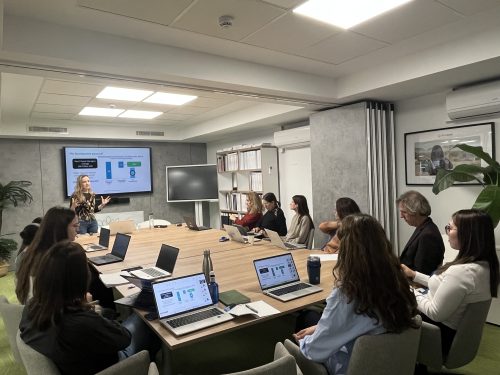
Recently, Tania Gómez Carrión, Chief Innovation Officer at DT Global Europe, led a session at our Madrid office on “Global Gateway: the EU Solution to the Development Gap,” where she shared how the European Union’s Global Gateway Strategy is redefining international development and development finance through sustainable investment and innovation.
The discussion explored how the EU is moving from traditional aid to investment-based development, leveraging innovation, partnerships, and private capital to connect goods, people, and services sustainably around the world.
The EU’s Global Gateway is not a budget, but a strategic framework designed to mobilize €300 billion in investments (2021–2027) through a coordinated Team Europe approach engaging all Member States, connecting public and private resources to drive sustainable global impact. It connects public goods, people, and services worldwide by focusing on five key areas: digital, climate and energy, transport, health, and education and research. The Global Gateway has an investment target comprised of grants, European Funds for Sustainable Development (EFSD) + guarantees, and funds from European Investment Bank (EIB), European Bank for Reconstruction and Development (EBRD), Development Finance Institutions (DFIs), and Export Credit Agencies.
“At a time when Official Development Assistance is shrinking in many countries, this financial framework promotes a shift to Development Finance, engaging multilateral development banks, private companies, and investment funds,” said Tania.
Strategically combining public grants with private financing to multiply impact, the Global Gateway will offer four new financial instruments: investment grants, technical assistance, guarantees, and risk capital. This blended finance model helps de-risk investments, attract private partners, and deliver sustainable, long-term results in key development sectors.
Following the Global Gateway Forum 2025, the European Union announced the launch of the Impact Investment Hub, a new mechanism designed to streamline access to Global Gateway opportunities and strengthen collaboration between public and private partners.
“As practitioners in international development, we have a unique opportunity to engage the private sector through a development-focused lens, demonstrating that sound management practices lead to sustainable and profitable investments,” said Tania. “DT Global is well-positioned to serve as a catalyst, aligning the interests of public and private stakeholders to shape a better future and amplify our role for positive change.”