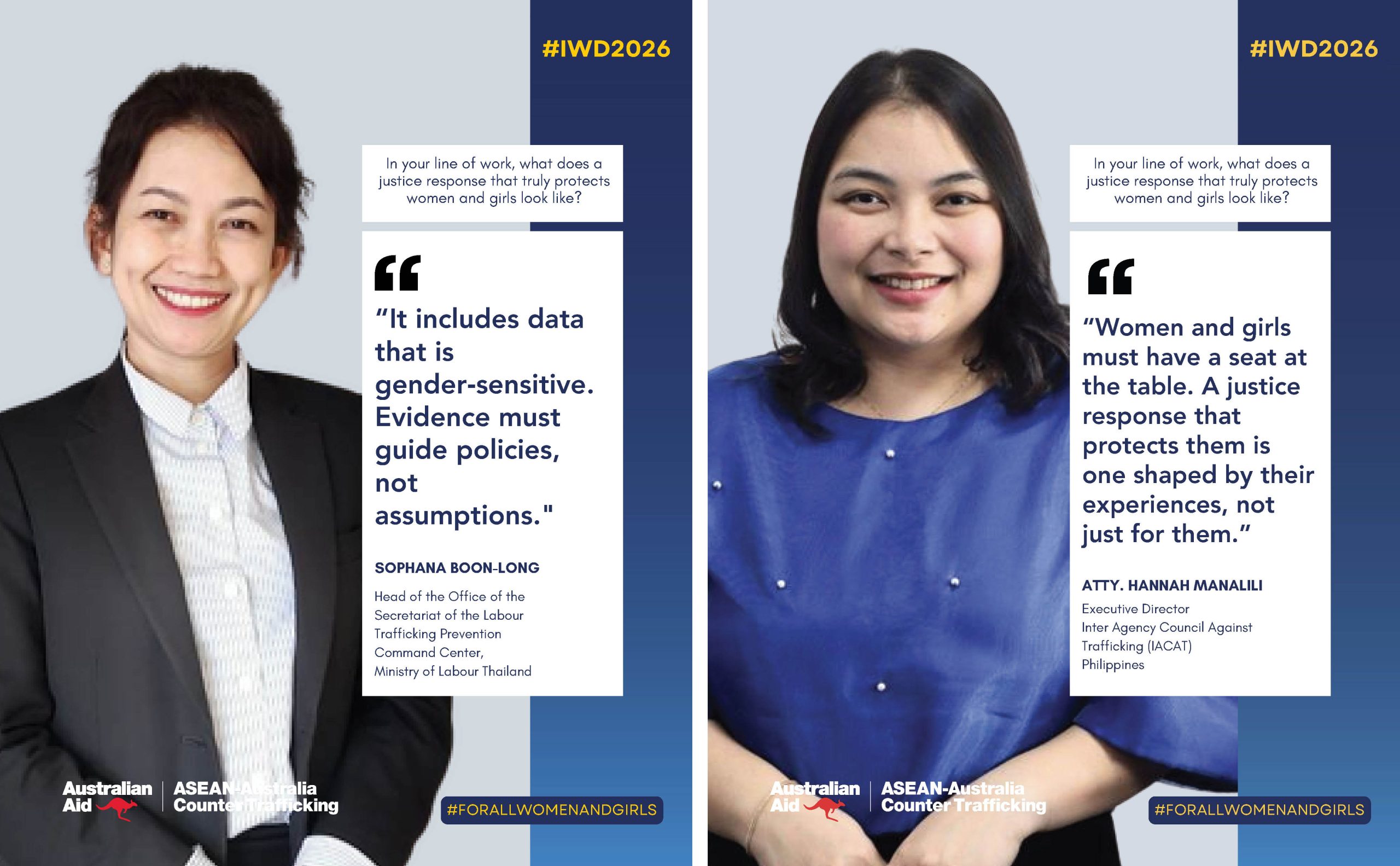
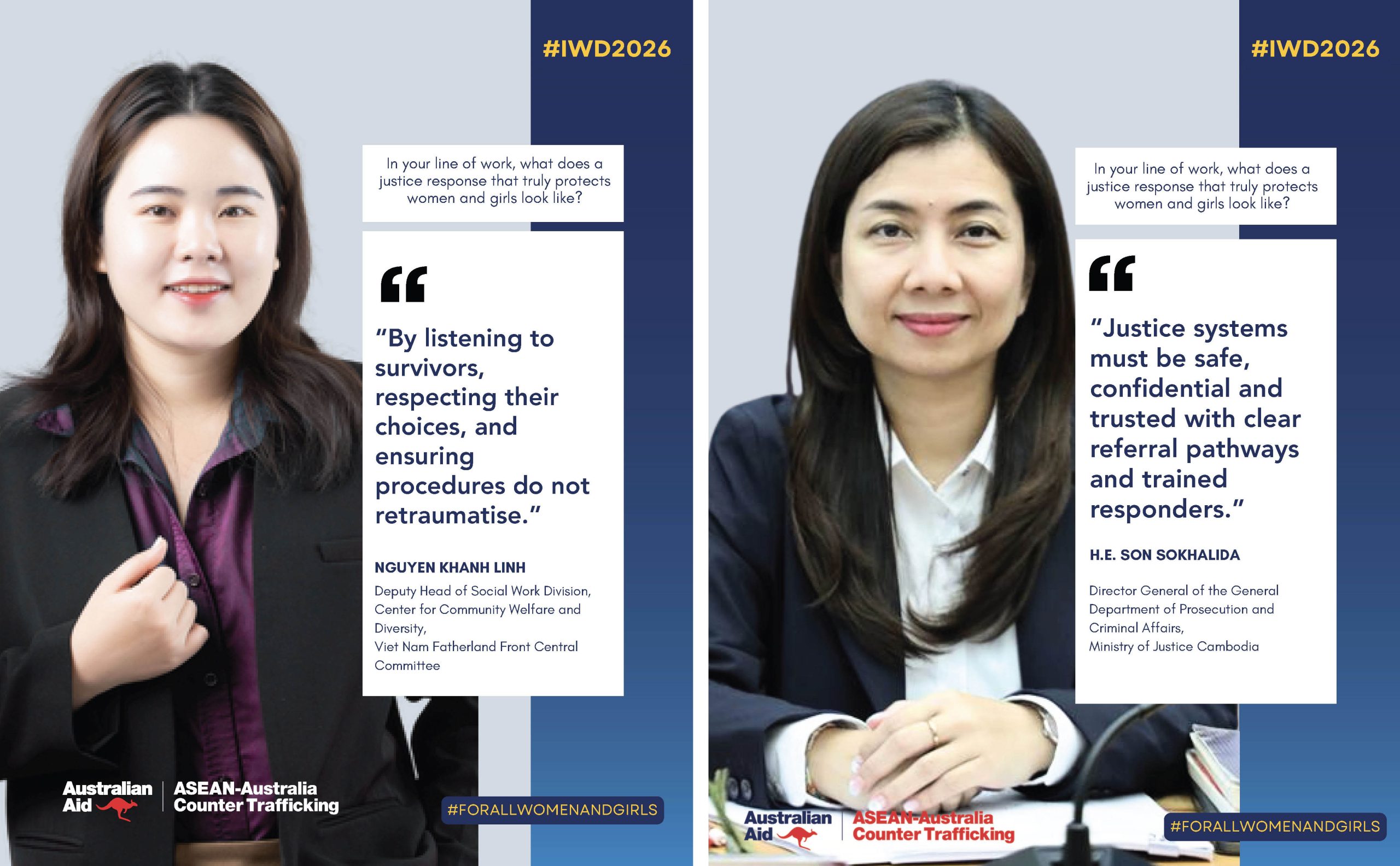
What would it mean if every woman and girl could rely on justice systems that truly protect her?
This year’s UN International Women’s Day theme, “Rights. Justice. Action. For ALL Women and Girls,” highlights that equality depends on systems that work when they are needed most.
Yet globally, women still hold only 64% of the legal rights that men hold, and at the current pace, it could take 286 years to close global legal protection gaps.
At DT Global, we believe those timelines are not inevitable. Through the ASEAN-Australia Counter Trafficking (ASEAN-ACT) program, funded by the Australian Government, we work with ASEAN institutions, governments, and civil society to strengthen justice responses to trafficking in persons and better protect women and girls.
In Southeast Asia, trafficking in persons remains one of the region’s most serious crimes, disproportionately affecting women and girls.
The ASEAN Convention against Trafficking in Persons, Especially Women and Children (ACTIP) outlines ASEAN’s shared commitment to prevent trafficking, protect victims, and hold perpetrators accountable. But its impact depends on how effectively institutions coordinate and respond to evolving forms of exploitation.
Through ASEAN-ACT, DT Global supports ASEAN Member States and regional bodies to translate these commitments into practical action through strengthening justice systems and promoting more survivor-centred responses.
One of the fastest-growing challenges in the region is trafficking for forced criminality, including online scamming operations.
Women from a range of backgrounds are trafficked into large-scale compounds where they may be forced to conduct scams, experience sexual exploitation, or recruit other victims. Some attempt to escape by becoming pregnant, exposing themselves to serious health risks.
Responding effectively requires justice practitioners who can recognise the complex nature of trafficking. Through ASEAN-ACT, DT Global supports dialogue and expert exchange to strengthen the application of the non-punishment principle, a key protection for victims.
Women coerced into illegal activities (such as online fraud, drug trafficking, or sex work) may be arrested without an assessment of whether they are victims of trafficking.
To address this, ASEAN-ACT supports justice practitioners to assess cases through better recognition of the three interrelated elements of trafficking:
Applying the non-punishment principle helps authorities recognise when individuals were compelled to commit unlawful acts because of trafficking. When implemented effectively, it protects survivors from criminalisation and allows them to safely access support and participate in investigations.
Building justice systems that work for women and girls also means addressing practices that increase vulnerability to exploitation.
In parts of Southeast Asia, child and forced marriage still limit girls’ education, expose them to violence, and, in some cases, intersect with trafficking.
To strengthen prevention efforts, ASEAN-ACT has supported ASEAN bodies to develop regional Guidelines on Child and Forced Marriage, providing a shared framework to raise awareness, identify risks, and respond to cases where women and girls are trafficked for the purpose of forced marriage.
Justice for women and girls depends on more than courts and law enforcement. It also requires coordination between labour inspectors, social services, technology companies, and communities that can recognise the signs of trafficking.
When these actors work together, justice systems become more responsive, and survivors experience greater safety and dignity.
This International Women’s Day, DT Global recognises the partnerships and collective commitment required to ensure justice becomes an everyday reality for women and girls across ASEAN.